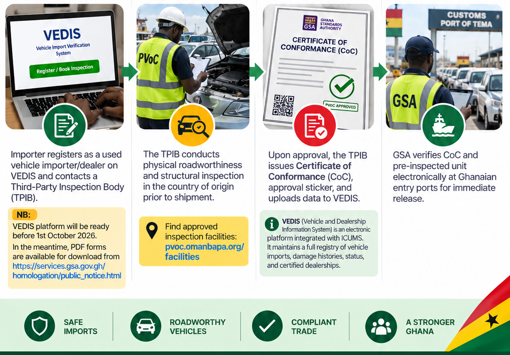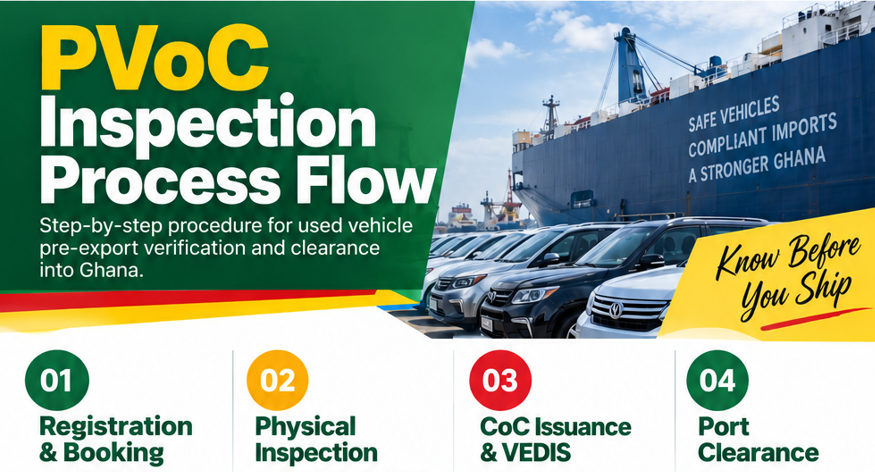
Before purchasing a used vehicle for export to Ghana, understand the applicable Vehicle PVoC requirements.
With Ghana’s Vehicle PVoC Programme entering its enforcement phase today, vehicle importers need to make compliance part of their purchasing decision.
The most important principle is simple:
Know before you ship.
1. Understand the Requirements
Before purchasing a used vehicle for export to Ghana, understand the applicable Vehicle PVoC requirements.
The Ghana Standards Authority (GSA) establishes and enforces the relevant standards and regulatory requirements, including GS 4510:2022.
Do not rely only on information provided by a seller or informal sources. Where necessary, seek clarification through the appropriate official channels.
2. Identify the Vehicle Correctly
Accurate vehicle information is essential to the verification process.
Information such as the VIN or chassis number, make, model, year of manufacture, country of export and supporting documents should be accurate and consistent.
Errors or inconsistencies can create unnecessary delays.
3. Consider Compliance Before Purchase
This is particularly important when purchasing vehicles through auctions, overseas dealers or exporters.
Before committing to a purchase, consider whether the vehicle can meet the applicable Ghanaian requirements and whether the required verification can be completed.
Compliance should be part of the buying decision—not an afterthought.
4. Arrange the Required Verification
The PVoC process involves verification of the vehicle against the applicable requirements before export.
Importers and exporters should work through the appropriate inspection and verification arrangements for the country from which the vehicle is being exported.
The objective is to identify conformity issues before the vehicle is shipped to Ghana.
5. Obtain the Required Certificate
Where the vehicle successfully completes the applicable conformity process, the required Certificate of Conformity (CoC) provides evidence that the vehicle has undergone the prescribed verification.
Importers should retain the relevant documentation and ensure that vehicle details are consistent across their records.
6. Coordinate With Your Shipping Partners
Vehicle importation involves several parties—importers, exporters, dealers, inspection facilities, shipping companies, freight forwarders and clearing agents.
Everyone handling the transaction should have accurate vehicle and documentation information.
Good coordination before shipment can help reduce avoidable delays later.
Omanbapa: Helping You Navigate the Process
Omanbapa Auto & PVOC Ltd provides practical information and guidance to stakeholders navigating Ghana’s Vehicle PVoC process.
Our role is to help importers, exporters, dealers and other stakeholders understand the process and prepare appropriately.
GSA sets and enforces the standard. Omanbapa helps you understand it.
The PVoC process represents an important shift toward checking conformity before a vehicle reaches Ghana.
The principle is straightforward:
Know the requirements. Verify the vehicle. Obtain the required certification. Then ship.
For more inofrmation contact us via info@omanbapa.org or visit www.pvoc.omanbapa.org
Related Media