Ghana's automotive market is entering a new phase; one where information, compliance and traceability will become increasingly important alongside price and appearance.
Accra, Ghana — August 25, 2026
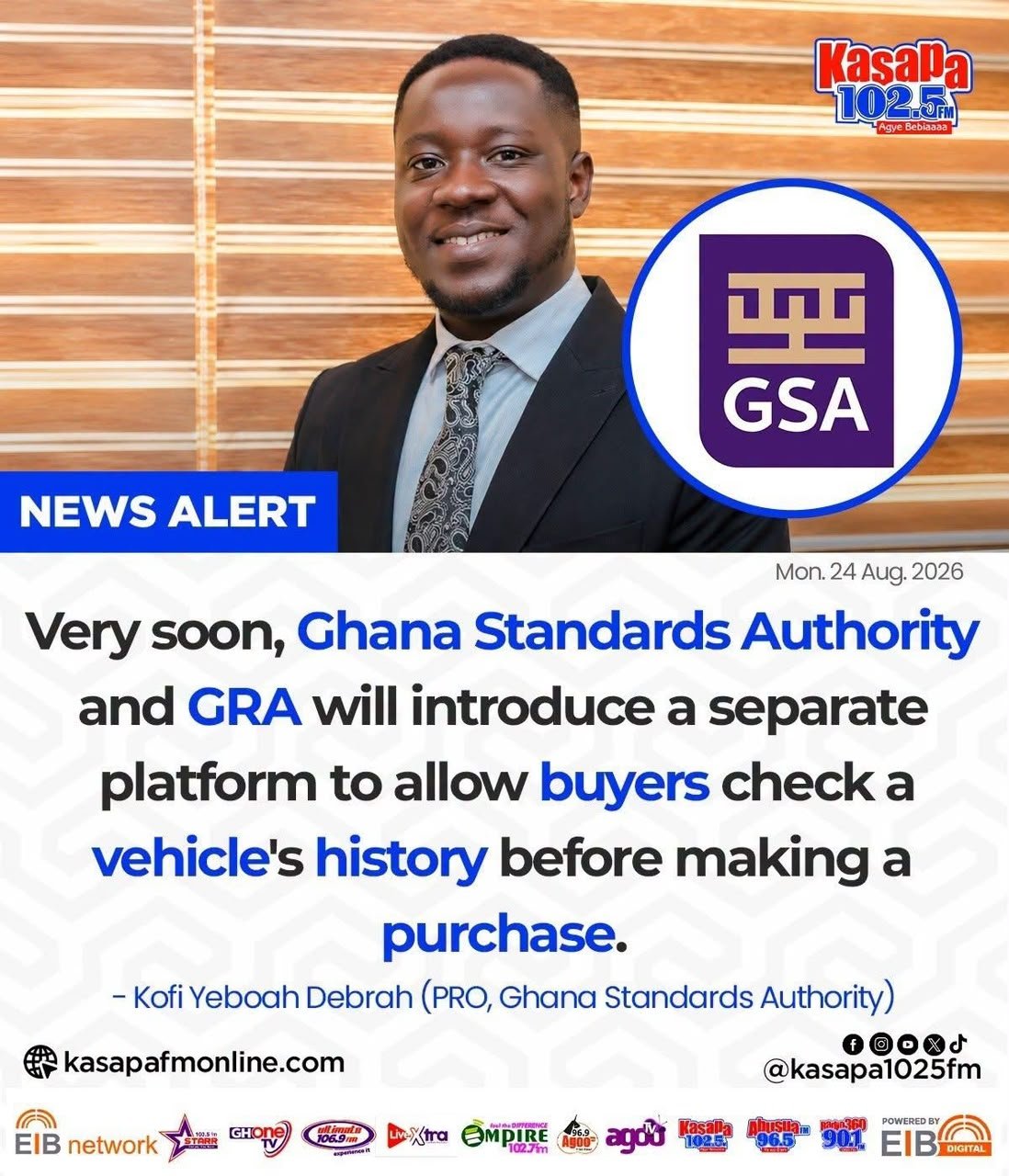
The Ghana Standards Authority (GSA) and the Ghana Revenue Authority (GRA) are set to introduce a dedicated digital platform that will allow prospective vehicle buyers to check the history of a vehicle before making a purchase.
The development was disclosed by Kofi Yeboah Debrah, Public Relations Officer of the Ghana Standards Authority, in an interview reported by Kasapa 102.5 FM on August 24, 2026.
The proposed platform represents another important step toward improving transparency, consumer protection and traceability in Ghana's used-vehicle market.
A New Era of Vehicle Transparency
For many years, vehicle buyers in Ghana have had limited access to reliable information about the history of imported used vehicles. Important details such as accident records, previous ownership, damage history, import documentation and other vehicle-related information may not always be readily available to prospective buyers.
The proposed GSA-GRA platform could significantly change this situation by giving buyers access to verified information before committing their money.
This is particularly significant as Ghana prepares for stricter enforcement of vehicle import standards from 1 October 2026.
The GSA has stated that the enforcement of applicable national vehicle standards, including GS 4510 on requirements for the importation of used vehicles, is intended to ensure that vehicles entering Ghana meet the required safety, quality and environmental standards.
From Pre-Shipment Inspection to Consumer Verification
The proposed vehicle-history platform would complement Ghana's broader move towards stronger vehicle conformity assessment and traceability.
Under the new regime, used vehicles are expected to comply with applicable Ghana Standards before shipment to Ghana. The GSA has also emphasised the need to prevent unsafe, substandard and environmentally harmful vehicles from entering the country.
This creates a more complete compliance chain:
Vehicle sourcing → Vehicle history verification → Pre-shipment inspection → Conformity assessment → Certificate of Conformity → Importation → Customs processing → Consumer purchase
The objective is not simply to regulate vehicles at the port. It is increasingly about creating traceability throughout the vehicle's lifecycle.
What This Means for Vehicle Buyers
For consumers, the proposed platform could become an important tool when purchasing both imported and locally available used vehicles.
Before paying for a vehicle, a buyer could potentially verify important information associated with the vehicle identification number (VIN) and other official records.
This would help buyers make more informed decisions and could reduce the risk of purchasing vehicles with undisclosed accident, flood, fire or structural damage.
The GSA has recently highlighted several categories of vehicles that should not enter Ghana, including flood-damaged vehicles, fire-damaged vehicles and vehicles with compromised chassis or safety-cage structures.
A Significant Development for Ghana's Automotive Industry
The development also has implications for vehicle importers, dealers, clearing agents, inspection companies, insurers, financiers and other businesses within the automotive value chain.
A more transparent vehicle-information ecosystem can help legitimate operators distinguish themselves from businesses that rely on incomplete or misleading vehicle information.
It can also support stronger risk assessment by insurers and financiers and improve confidence among consumers purchasing vehicles through formal dealerships.
For companies involved in vehicle inspection and conformity assessment, reliable digital access to vehicle information could further strengthen the integrity of the pre-shipment and certification process.
Omanbapa's Perspective
The move towards greater vehicle-history transparency is consistent with the broader objective of strengthening conformity assessment and responsible vehicle importation in Ghana and across Africa.
For Omanbapa Auto & PVoC, the development reinforces an important principle:
A vehicle should not only be inspected before shipment; its compliance and history should be traceable throughout the import process.
The combination of vehicle-history verification, pre-shipment inspection, conformity certification and digital traceability has the potential to create a safer and more accountable automotive import ecosystem.
What Buyers Should Do
Until the proposed GSA-GRA platform becomes operational, prospective vehicle buyers should exercise caution and request as much verified information as possible before purchasing a used vehicle.
Buyers should pay particular attention to:
- Vehicle Identification Number (VIN)
- Previous accident history
- Flood or water damage
- Fire damage
- Chassis and structural condition
- Mileage history
- Original steering configuration
- Import and conformity documentation
- Certificate of Conformity where applicable
- Vehicle age and applicable Ghana Standards
Ghana's automotive market is entering a new phase; one where information, compliance and traceability will become increasingly important alongside price and appearance.
The proposed vehicle-history platform could become an important part of that transformation.
Source: Kasapa 102.5 FM report, August 24, 2026; Ghana Standards Authority public information and recent reporting on the October 1, 2026 vehicle import standards enforcement.